The Majestic Scale of India: A Global Giant Defined by Its Dimensions
India, officially known as the Republic of India or Bhārat, is not merely a country but a subcontinent-sized entity whose sheer scale and geographic diversity captivate observers worldwide. The **Größe Indien** (size of India) is a fundamental attribute that underpins its immense cultural variety, economic potential, and pivotal strategic importance on the global stage. From its sprawling plains to towering mountain ranges and extensive coastlines, India’s geography is a testament to its grandeur.
With a staggering land area of 3,287,263 square kilometers, India proudly holds its position as the world's seventh-largest country. This monumental landmass accounts for approximately 2.4 percent of the Earth's total land area, making it a significant player in the global geographic landscape. To put this in perspective, India stretches an impressive 3,214 kilometers from its northernmost point to its southern tip and spans 2,933 kilometers from east to west. This vast expanse encompasses an incredible array of ecosystems, climates, and topographical features, contributing to the nation's unparalleled biodiversity and regional distinctiveness. For a deeper dive into these figures, explore
India's Geographic Scale: 7th Largest Country, 3.2 Million Sq Km.
Beyond its land area, India is also the world's most populous country, a demographic fact that profoundly influences its resource management, development strategies, and socio-economic fabric. This combination of vast territory and a massive population makes India a unique and dynamic nation. Learn more about this dual identity in
India's Vast Dimensions: Most Populous Nation & Global 7th Largest. Situated in Southern Asia, India occupies a central position that has shaped its historical trajectory and continues to define its future as a global power.
Navigating India's Extensive Borders: Land and Sea
India's geographical boundaries are as diverse as its internal landscape, comprising both lengthy land borders and an expansive coastline that define its interactions with neighboring countries and the broader maritime world.
Land Borders: A Tapestry of Nations and Terrains
India shares an extensive land border, stretching approximately 15,200 kilometers. This perimeter interfaces with a diverse array of countries, each presenting unique cultural, historical, and geopolitical dynamics. India's land neighbors include:
- Pakistan to the west, sharing a border that runs through varied terrains, from desert to mountains.
- Afghanistan in the northwest, a short but strategically significant border.
- China to the north and northeast, marked by the formidable Himalayan ranges, which represent one of the most challenging borders globally.
- Nepal and Bhutan to the north, forming largely open or semi-open borders with distinct cultural exchanges.
- Bangladesh to the east, one of the longest and most complex land borders, characterized by riverine landscapes and dense populations.
- Myanmar (Burma) to the far east, featuring hilly and forested terrain.
These borders are not just lines on a map; they are living frontiers that influence trade, migration, security, and cultural exchange. Managing such a vast and varied land frontier is a constant exercise in diplomacy, defense, and development.
Coastal Line: Gateway to Global Trade and Maritime Influence
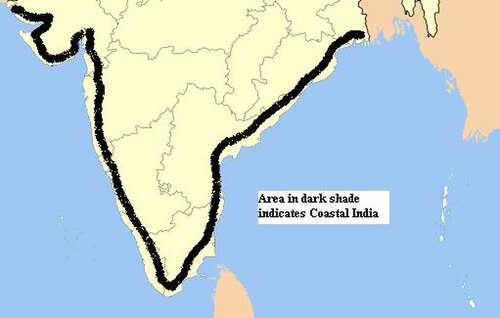
Complementing its extensive land borders is India's impressive coastline, which measures approximately 7,516.5 kilometers. This includes the mainland coast and the shores of its island territories. The Indian peninsula tapers southwards, flanked by two major water bodies:
- The Arabian Sea to the southwest, home to vibrant port cities and significant trade routes.
- The Bay of Bengal to the southeast, connecting India to Southeast Asia and beyond.
These converge at the Indian Ocean, making India a prominent maritime nation. This vast coastline is crucial for India's economy, supporting extensive fishing industries, facilitating international trade through numerous ports, and serving as a vital artery for strategic defense. The coastal regions also boast distinct cultures, cuisines, and ecosystems, from the backwaters of Kerala to the mangrove forests of the Sunderbans.
Strategic Crossroads: India's Geopolitical Importance
India's location is arguably its greatest geopolitical asset. Situated in the northern hemisphere, between 8 degrees 4 minutes and 37 degrees 6 minutes north latitude, and 68 degrees 7 minutes and 97 degrees 25 minutes east longitude, its position is intrinsically strategic. This extensive latitudinal and longitudinal spread accounts for the incredible diversity of its climate zones, ranging from the tropical monsoon climate of the south to the alpine conditions of the Himalayas.
A Maritime Hub
The Indian Ocean, named after the country itself, underscores India's unparalleled maritime significance. India sits centrally within this vast ocean, controlling vital sea lanes of communication that connect the Middle East and Africa with Southeast Asia and Australia. This makes India a natural custodian of regional security and a critical node in global trade networks, particularly for oil and gas transit. The city and cape of Kanyakumari, at the southernmost tip of the Indian peninsula, marks the confluence of the Arabian Sea, the Bay of Bengal, and the Indian Ocean, symbolically representing India's deep connection to these waters.
The Himalayan Shield
To its north, India is protected and defined by the majestic Himalayas, the world's highest mountain range. These formidable mountains act as a natural barrier, influencing regional climate patterns by blocking cold Central Asian winds and trapping monsoon rains. They are also the source of several major perennial rivers, including the Ganges and the Brahmaputra, which are lifelines for millions across the Indo-Gangetic plains. The Himalayas are not just a physical barrier but a cultural and spiritual watershed, shaping the ethos of the northern Indian states.
Beyond the Mainland: Islands and Maritime Influence
India's territorial reach extends beyond its mainland, encompassing strategically important island territories that significantly bolster its maritime presence and economic zone.
The Andaman & Nicobar Islands
Located in the Bay of Bengal, the Andaman & Nicobar Islands are an archipelago of over 500 islands. These islands are not only a biodiversity hotspot but also serve as crucial strategic outposts, extending India's influence eastward towards Southeast Asia. Their location provides India with a watchful eye over key shipping routes and enhances its naval projection capabilities in a geopolitically dynamic region.
The Lakshadweep Islands
To the west, in the Arabian Sea, lie the Lakshadweep Islands. These coral atolls and islands, though smaller, are equally vital. They contribute to India's vast Exclusive Economic Zone (EEZ), which extends 200 nautical miles from its coast, granting the nation exclusive rights to exploit marine resources within this area. Both island groups underline India's aspiration and capacity to be a significant maritime power, securing its oceanic interests and contributing to regional stability.
The Unifying Diversity: Implications of India's Geography
The remarkable **Größe Indien** and its diverse geography have profound implications for virtually every aspect of the nation.
- Cultural and Linguistic Mosaic: The vastness has fostered an astonishing array of languages, dialects, customs, and traditions. Different geographical regions have given rise to distinct cultural identities, making India one of the most culturally rich nations on Earth.
- Climatic Zones: From the arid Thar Desert in the west to the humid tropical forests of the Northeast, and from the temperate valleys of the Himalayas to the scorching plains of the Deccan, India experiences almost every major climate type. This diversity supports a wide range of agricultural practices and natural resources.
- Economic Vibrancy: The varied topography allows for diverse economic activities. Fertile plains support agriculture, coastal areas thrive on fishing and trade, and mineral-rich plateaus underpin industrial development. India's geography dictates the distribution of resources and significantly influences its economic planning and infrastructure development.
- Environmental Challenges and Opportunities: The extensive coastline and diverse biomes make India vulnerable to climate change impacts like rising sea levels, extreme weather events, and habitat loss. However, this diversity also presents immense opportunities for ecotourism, renewable energy development, and scientific research into biodiversity.
- Strategic Challenges: While the Himalayas offer a natural defense, managing such extensive and varied borders requires significant military and diplomatic effort. The long coastline necessitates a robust naval presence to protect economic interests and secure maritime pathways.
Conclusion
India's sheer **Größe Indien**, its strategic location in South Asia and the Indian Ocean, and its extensive borders are defining characteristics that shape its identity as a global power. The interplay of its vast landmass, its central position in vital sea lanes, and the protective embrace of the Himalayas creates a geographic masterpiece. This intricate tapestry of land, sea, and strategic advantage not only underpins India's rich cultural heritage and economic dynamism but also solidifies its indispensable role in regional stability and global affairs. Understanding India's geography is key to appreciating its past, present, and future trajectory on the world stage.