India's Geographic Scale: A Colossal Presence on the Global Map
India stands as a monumental entity on the world stage, not just for its burgeoning population and ancient civilization, but prominently for its sheer geographic scale. As the seventh-largest country globally by land area, its vastness is a fundamental characteristic that shapes everything from its climate and biodiversity to its cultural tapestry and geopolitical influence. Encompassing an impressive 3,287,263 square kilometers (often rounded to 3.2 million sq km), India represents a significant portion of the Earth's terrestrial surface, specifically 2.4 percent of the world's total landmass.
Positioned strategically in Southern Asia, India occupies the majority of the Indian subcontinent, projecting southward into the expansive Indian Ocean. This unique geographical placement, combined with its immense dimensions, contributes to an unparalleled diversity that captivates travelers, researchers, and policymakers alike. Understanding the Größe Indien, or the magnitude of India, is key to appreciating its multifaceted nature and its critical role in both regional and global affairs.
Unpacking India's Vast Dimensions: From North to South, East to West
The true appreciation of India's geographic scale comes from exploring its extensive longitudinal and latitudinal spreads. Stretching significantly from the cooler northern climes to the tropical south, and from the arid western deserts to the lush eastern forests, India's landmass is a mosaic of different environments. It spans approximately 3,214 kilometers from its northernmost point to its southernmost tip, encompassing a dramatic range of ecosystems and human settlements. Similarly, its breadth from east to west measures around 2,933 kilometers, crossing multiple time zones if not for the unified Indian Standard Time.
- Latitude: India extends from 8 degrees 4 minutes North to 37 degrees 6 minutes North latitude. This wide latitudinal expanse contributes to the country's diverse climate zones, ranging from the tropical monsoon in the south to a more temperate climate in the northern highlands.
- Longitude: Longitudinally, India lies between 68 degrees 7 minutes East and 97 degrees 25 minutes East. This broad spread means that sunrise occurs significantly earlier in the eastern states like Arunachal Pradesh compared to the western state of Gujarat, though a single time zone helps manage daily activities across the nation.
This immense territorial spread is a primary driver of the nation's incredible natural and cultural diversity. From the snow-capped peaks of the Himalayas to the sun-drenched beaches of the peninsula, and from bustling megacities to tranquil rural villages, India's geographic scale dictates a truly 'world within a country' experience. For anyone looking to delve deeper into how these expansive dimensions influence the nation, you might find more insights in our article on India's Vast Dimensions: Most Populous Nation & Global 7th Largest.
Borders and Coastlines: Defining India's Strategic Edges
The boundaries of India are as extensive and varied as its interior, encompassing both formidable land borders and an impressive coastline. The country shares its terrestrial frontiers with several neighboring nations, creating a complex geopolitical landscape. India's land border stretches approximately 15,200 kilometers (with some sources citing 15,106.7 kilometers), a testament to its position at the heart of South Asia. These borders are characterized by an array of terrains, from the high Himalayas in the north to plains and riverine areas elsewhere.
Equally significant is India's extensive coastline, which measures approximately 7,516.6 kilometers (or 7,516.5 kilometers, depending on the precise measurement). This includes the mainland coastline and the shores of its numerous islands. This vast maritime edge plays a crucial role in trade, defense, and cultural exchange, linking India to global shipping routes and coastal economies. The peninsula is flanked by the Arabian Sea to the southwest and the Bay of Bengal to the southeast, both of which are arms of the mighty Indian Ocean that washes its southern shores. The southernmost tip of the Indian peninsula, Kanyakumari, symbolically marks the confluence of these three great water bodies.
India's island territories further underscore its maritime reach. The Andaman and Nicobar Islands, strategically located in the Bay of Bengal, and the picturesque Lakshadweep Islands in the Arabian Sea, are integral parts of the Indian Union. These island groups are not just biodiversity hotspots but also hold significant strategic value, extending India's exclusive economic zone and maritime influence. To learn more about how these boundaries shape the nation's interactions and strategic positioning, explore our article Explore India's Borders: Coasts, Landmass, and Strategic Location.
Geographic Features and Diversity: A World Within a Country
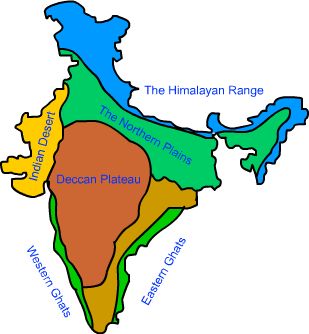
The expansive Größe Indien translates directly into an extraordinary range of geographical features, creating a topographical mosaic unrivaled by many nations. At its northern frontier lie the majestic Himalayas, the world's highest mountain range, which act as a natural barrier and a source of numerous perennial rivers that sustain the vast Indo-Gangetic Plain. This fertile plain, one of the most densely populated regions on Earth, is the agricultural heartland of India.
Moving south, the landscape transitions into the ancient Deccan Plateau, a large triangular plateau that rises from the coastal plains and is characterized by its volcanic origins and rich mineral resources. Flanking the Deccan are the Eastern and Western Ghats, mountain ranges that run parallel to the coastlines, influencing monsoon patterns and supporting unique biodiversity. Towards the west, the arid Thar Desert presents a stark contrast to the verdant Gangetic plains and the humid coastal strips.
Practical Insights into India's Geographic Diversity:
- Climate Variability: The diverse geography leads to varying climatic conditions. Northern India experiences distinct seasons, including cold winters, while the south remains largely tropical throughout the year. The monsoon, heavily influenced by geographical features, is a critical aspect of Indian life.
- Resource Distribution: Different regions boast distinct natural resources. The Himalayas are crucial for water resources and hydroelectric power, the Deccan Plateau for minerals, and the plains for agriculture.
- Cultural Impact: The physical barriers and open plains have shaped India's linguistic and cultural diversity, leading to a rich tapestry of traditions, languages, and cuisines across its various regions.
- Travel Planning Tip: When planning a trip to India, consider the vast distances and diverse climates. What's ideal weather in Rajasthan might be the peak monsoon in Kerala. Researching regional climates and transportation logistics is crucial for a smooth journey across this immense country.
The Impact of India's Size: Population, Economy, and Global Footprint
India's geographic scale is inextricably linked to its human dimension. With its massive land area, it also holds the distinction of being the most populous country in the world, having recently surpassed China. This colossal population, estimated to be over 1.4 billion people, coupled with its vast territory, presents both immense opportunities and significant challenges. The sheer number of people spread across such a diverse landscape means that demand for resources, infrastructure, and governance is unparalleled.
Economically, India's large landmass provides a wealth of natural resources, from agricultural land to mineral deposits, supporting a rapidly growing economy. Its strategic location in the Indian Ocean, combined with its extensive coastline, facilitates robust international trade. The diversity of its regions allows for a wide array of economic activities, from high-tech industries in Bengaluru to textile manufacturing in Gujarat and traditional agriculture in the plains.
Globally, the Größe Indien translates into a substantial international presence. As a nuclear power and a rising economic force, its geographic spread and demographic weight contribute significantly to its geopolitical importance. India is a key player in international forums, and its policies often have far-reaching implications for global trade, climate, and security.
Expert Analysis: The administrative challenge of governing such a vast and diverse nation is profound. It necessitates a robust federal structure, regional planning, and an intricate network of infrastructure to connect its disparate parts. The ongoing development of highways, railways, and digital connectivity across the length and breadth of India reflects a concerted effort to leverage its geographic scale for inclusive growth and national integration.
In conclusion, India's geographic scale is far more than just a statistic; it is a defining characteristic that permeates every aspect of the nation. From its towering Himalayas to its sprawling coastlines, and from its varied climates to its unparalleled human diversity, the sheer vastness of India creates a unique and dynamic environment. Understanding the true Größe Indien offers invaluable insight into its past, present, and its burgeoning future on the global stage.